




How the Blockchain Gives You Away: Bitcoin Privacy Attacks Explained
The core idea: connecting your addresses
Every bitcoin transaction is written into a public ledger that anyone can read, forever. Your name is not printed next to your coins, but that is thinner protection than it sounds. Over the years, analysts have worked out a set of clever tricks for connecting the dots between addresses and the people behind them. This guide explains the most common tricks in plain language, and what you can do about each one. For a deeper technical reference, the Bitcoin Wiki’s privacy page is a good starting point.
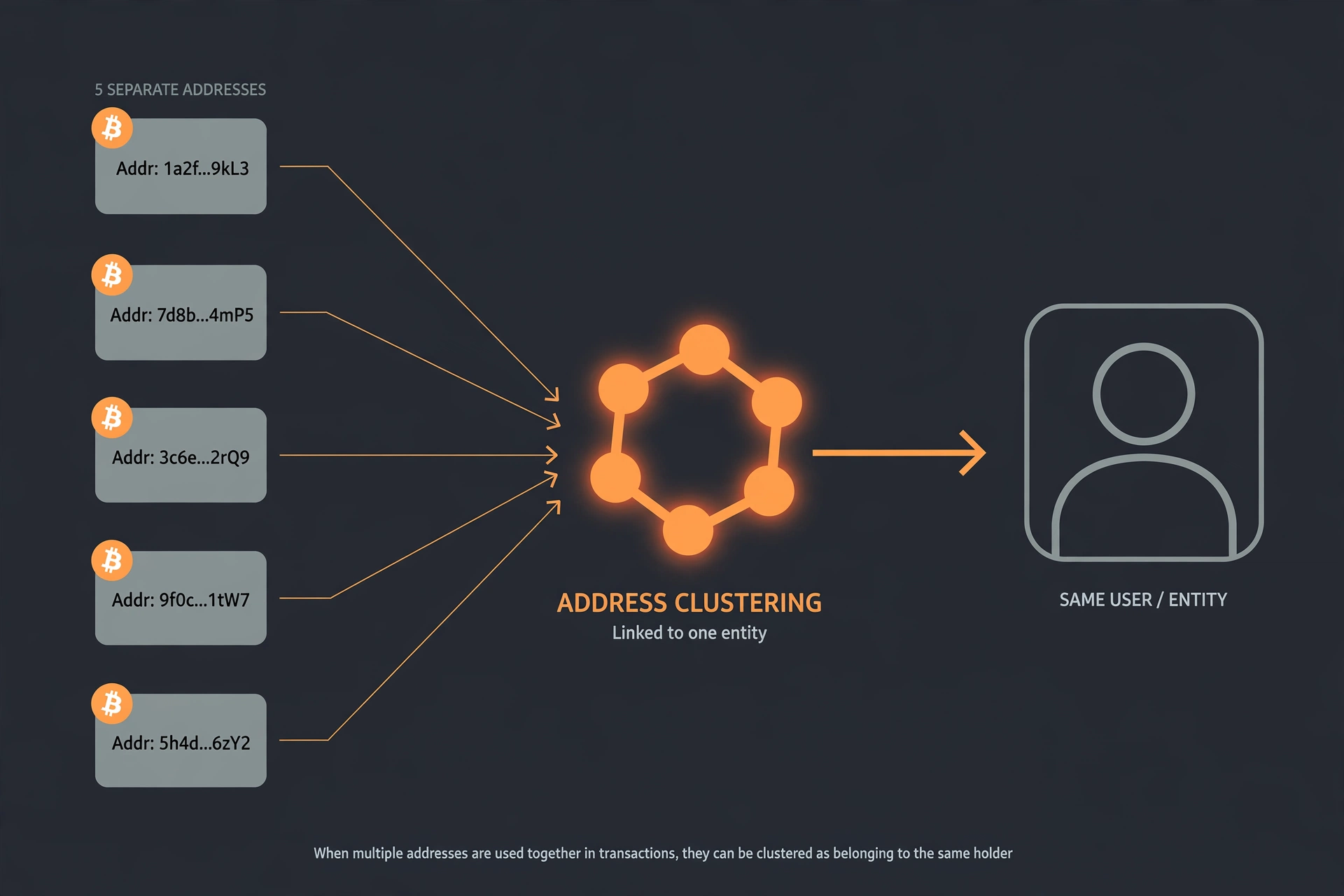
A single bitcoin address, on its own, tells an analyst almost nothing. It is just a random-looking string of characters. The real game is linking many addresses into one group that probably belongs to the same person or company. Analysts call these groups clusters.
Once a cluster is built, a single link to a real identity can expose the whole thing. That link might be a withdrawal from an exchange account with your name on it, an address you posted on a forum years ago, or a payment for something bought online. From there, every trick below helps the cluster grow.
Trick 1: the multi-input clue
When one transaction spends coins from several addresses at once, analysts assume all of those addresses belong to the same owner. Most of the time the assumption holds, because spending them requires holding all the matching private keys.
This is the single most-used trick in blockchain analysis, and surveillance companies rely on it heavily. The main exception is CoinJoin, a technique where strangers combine their coins into one transaction precisely to break this assumption.
What helps: avoid sweeping coins from different sources into a single transaction when privacy matters. If you need to mix spending sources, look into CoinJoin tools first.
Trick 2: finding your change
Say you pay 1 BTC using a coin worth 10 BTC. The remaining 9 BTC comes back to you as change, usually at a brand-new address. If an analyst can tell which output is the change, they have just linked your old addresses to a fresh one. There are several tells:
Reused addresses. Fresh change addresses are generated by your wallet automatically. Payment addresses, by contrast, get passed between humans, and humans get lazy and reuse them. A reused address in a transaction is almost certainly the payment, not the change.
Peeling chains. Large holders like exchanges and mining pools often peel small payments off one big coin, over and over, sending the remainder to a new change address each time. After hundreds of hops this leaves a long, visible chain that is easy to follow.
Round numbers. Payments are often round amounts: 0.1 BTC, or something close to $100. The leftover change is then an odd-looking number like 1.78213974 BTC. The odd one out is usually the change.
Fee bumps. When a transaction is stuck, you can replace it with a version that pays a higher fee. The extra fee usually comes out of the change output. An analyst watching unconfirmed transactions sees both versions, and the output that shrank is the change.
Wallet fingerprints. Different wallet apps build transactions in slightly different ways: address types, input ordering, fee behavior, even signature formatting. When several transactions share the same fingerprint, the change outputs stand out.
The unnecessary input test. If a transaction has inputs of 2 BTC and 3 BTC and outputs of 4 BTC and 1 BTC, ask: could the 2 BTC input alone have covered a 1 BTC payment? Yes, and more cheaply. So the payment is probably the 4 BTC output, and the 1 BTC output is the change.
What helps: use a wallet with thoughtful coin selection, avoid round-number payments when privacy matters, and accept that no wallet is perfect. Every leak you close makes you more expensive to track.
Trick 3: dust and forced payments
An attacker can send a tiny speck of bitcoin, called dust, to an address you have already used. The hope is that your wallet will one day spend that dust together with your real coins. The moment it does, the multi-input clue links the dusted address to everything else in the transaction.
The defense is simple: never spend dust that lands on an already-used address. Good wallets are built to leave it sitting there untouched.
Trick 4: amount and timing clues
Amounts are public, and that alone can be enough. If someone knows you paid roughly $5,000 for a trip, they can search the blockchain for outputs near that value in the right time window. Even a few matches narrow the field dramatically. Timing works the same way: knowing roughly when you transacted shrinks the search space.
What helps: be careful what you share publicly. Amounts, dates, and addresses posted on social media become search clues. For transfers where privacy really matters, consider breaking them into pieces instead of one conspicuous payment.
Trick 5: taint and the transaction graph
Analysts draw maps of which addresses paid which, forming a giant graph of money flows. “Taint” analysis follows coins forward from a known address, marking everything they touch. On its own this is a weak trick, because coins change hands: donations, exchange withdrawals, and everyday spending muddy the trail fast. But layered on top of the other techniques, it adds confidence to a cluster.
Trick 6: the mystery shopper
Sometimes the trick is not technical at all. An attacker can simply buy something from you. The address you hand them at checkout is now confirmed as yours, and every technique above applies from that starting point. Anyone with a public donation address or an online store is exposed to this by design.
Simple habits that protect your privacy
You do not need exotic tools to get most of the benefit. These habits close the biggest leaks:
- Never reuse addresses. Let your wallet generate a fresh address for every receive.
- Separate your purposes. Keep savings, everyday spending, and exchange withdrawals in different wallets or accounts.
- Do not mix sources. Avoid combining coins from different origins in one transaction unless you must.
- Consider CoinJoin for coins where privacy truly matters.
- Watch what you post. Amounts, dates, and addresses shared online become search clues.
- Learn coin control. A good hardware wallet lets you choose exactly which coins to spend. If you are setting up long-term storage, our multisig wizard walks you through the options, and our wallet guide covers which devices handle privacy well. You can browse the devices themselves in the shop.
Perfect privacy on a public blockchain is genuinely hard. But most leaks come from a handful of avoidable habits, and analysts go after the easy targets first. Close the easy leaks and you become expensive to track, which is the realistic goal.
When you are ready to choose your tools, our compatibility checker shows which hardware wallets work with the apps you need for coin control.